

Paddle 101
The very basics of paddle for new players

Paddle in a Nutshell
Platform Tennis (aka: Paddle) is a niche racket sport played outside in the winter.
It’s played on a raised court (hence the name “platform tennis”) 1/3 the size of a tennis court surrounded by a 12’ high chicken wire cage. Invented in 1928 in New York by golfers looking for something active to do in the winter, the court was originally raised to allow shoveling snow off it. In later years, the raised platform allowed a convenient place to install propane heaters to melt snow and ice.
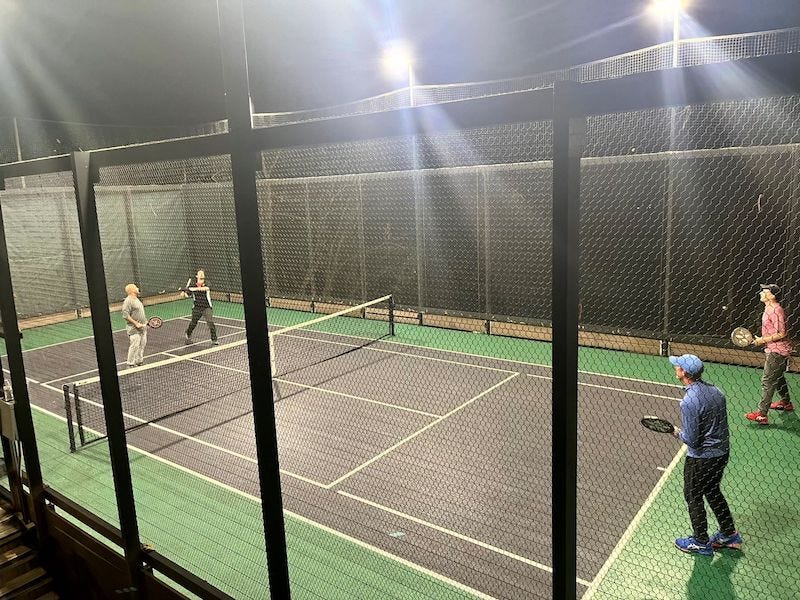
The game is played with paddles (closer to a Padel paddle than a Pickleball paddle) and a solid rubber ball with the same rules as tennis aside from 2 major differences:
You only get one serve
Balls can be played off the screens
It is almost exclusively played as a doubles sport from October to February and has a thriving league system in the Northeast and Upper Midwest with a growing presence in the Mid-Atlantic East Coast.
Basic Strategy and Positioning
Paddle is a game of controlled aggression. Tennis has been described as “a game of errors”, but this is doubly true for Paddle since there are so few true “winners” (aka: passing shots that end the point) since players have the ability to play passing shots off the screens.
Because the court is so small, there is a distinct geometric advantage to being at the net. Hence, the primary goal if you’re at the baseline is to take the net. When you have the net, you try to avoid their weapons and extract an error – typically with a tough corner shot or a drive error.
Players move forward or back together as a team - not staggered like in tennis. Once a team attains the net, the other team retreats to the baseline as a pair.
Three Phases of the Game
The game can be broken up into 3 distinct phases:
Serve and volley
Baseline play
Net play
Serve and Volley
The main goal of the serve is to take the net - not to win the point. The serve and volley go hand-in-hand.
Hard serves may get you a lob instead of a drive return, but could also be driven back at you faster than you have time to get in position for a good first volley.
Slower serves may have a higher percentage of going in and give you time to get further in for that first volley, but can also set up big drives for your opponents.
Baseline Play
The basic goals for baseline play are to:
Put pressure on the server’s first volley with a tough drive at their feet.
Lob to push your opponent off the net and set up a drive.
Most of your shots from the baseline will be neutral or defensive lobs. Deep lobs will prevent difficult overheads and eventually extract a short reset overhead that you or your partner can drive.
Net Play
Once you attain the net, you are in the driver’s seat. There is no urgency to hit a perfect offensive overhead to win the point so long as you keep the balls away from your opponents’ weapons (typically the forehand drive).
Soft, deep middle reset overheads and soft side-back overheads are going to be your primary tools at the net. Just get comfortable in the saddle and prepare to be more patient than the baseline team.
Going Further
This is my collected “starter pack” for new paddle players. Most of the videos in this playlist are only a few minutes long and will go a long way toward cementing the fundamentals of the game:
YouTube Playlist: Intro to Paddle
Keep grinding, and I’ll see you on the court!